

International challenge takes students to Google’s Asia Pacific headquarters
The full-time Denver MBA (DMBA) program at the University of Denver’s Daniels College of Business incorporates entrepreneurship, social good, and corporate and international business challenges throughout its academic curriculum. For their final challenge, second-year DMBA students voted to consult with (and travel to) businesses in Singapore due to the country’s hub of finance and technology.
Daniels staff and faculty paired groups of four students with Singapore businesses to solve business cases leading up to the 10-day international trip last December. Travel partner WorldStrides helped Daniels plan the itinerary and coordinate visits to Singapore-based organizations, including the U.S. Embassy, Foreword Coffee and Google.
This is how Dr. Siddhartha Paul Tiwari heard that 27 DU MBA students were interested in visiting Google’s Singapore office.
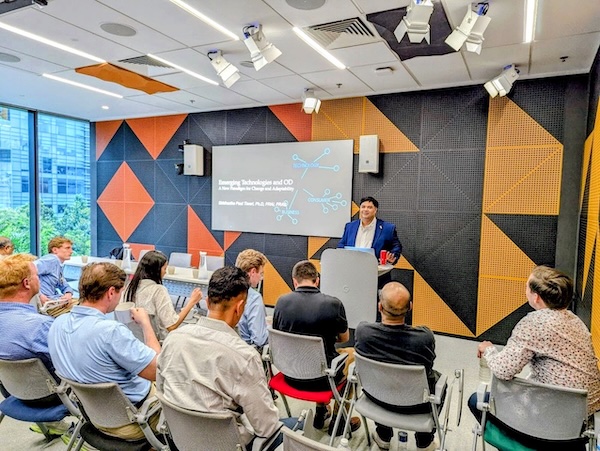
Tiwari began his tenure in the tech giant’s learning and development department nearly 20 years ago and now serves as Google’s policy manager for Android/Play in the Asia Pacific region. Leveraging his critical role in mobile app trust and safety, he designs customized curricula for university students, translating real-world industry challenges into valuable academic lessons that bridge academic theory with practical application.
He’s shared custom curricula with students from various universities and institutions including Stanford, Harvard, and now the University of Denver.
Tiwari successfully navigated an expedited approval process for the group visit, which typically takes six to nine months to plan. The Asia Pacific headquarter office hosts visits with regional governments, so additional layers of permissions are required to adhere to Google’s security protocols in Singapore.
His planning process also included a video chat with Daniels management professors Doug Allen and Pallab Paul. Understanding their objectives for the students’ visit allowed Tiwari to create a fully custom, three-part curriculum.
First, external guest Mustafa Rasheed, a venture capitalist and management consultant, delivered a lecture on the Singapore startup business ecosystem and venture capital funding differences between the Singapore and U.S. markets.
Next, Tiwari shared his career background, which has taken him to multiple Google campuses over 19 years, including stints in Japan and India. He said he finds Singapore to be “a multicultural country” that’s welcoming to international visitors due to its safety and predominant use of the English language. He also lent insight into his experiences working with artificial intelligence and mobile technology policies for Google products.
Tiwari then chaired a panel discussion with Allen, Paul, Rasheed and Anshul Goel, a member of Google’s Android engineering team, who shared a business case regarding satellite phone functionality.
“This was not a curriculum that I picked from a deck. This was based on the needs of the program. That pre-alignment with professors Paul and Allen led to the curation of a specific curriculum,” Tiwari emphasized in a conversation with Daniels’ newsroom.
In a follow-up note to the MBA team, Tiwari wrote that successful industry student sessions depend on three factors: enthusiastic student engagement, active faculty involvement and dedicated facilitation.
“All three elements worked together seamlessly, resulting in a truly successful outcome,” he observed. “The session was highly engaging. I truly appreciated the enthusiasm and active participation by both the students and faculty. The energy, curiosity, well-thought questions and engagement made the experience memorable.”
Dual MBA and Master of Accountancy student Joanna Guhl said the Google office was the “standout” among all the Singapore excursions.
“It was everything I expected and even more beautiful. It was well laid out, warm, welcoming, professional and felt like a cool place to work,” she said.
Guhl added that Tiwari’s warmth, encouragement and eagerness to answer students’ questions left a lasting impression.
“I pictured someone higher up in a company like Google to care less about students and people who are just starting new careers, but he was the opposite,” she said. “He was a phenomenal person for us to be able to listen to and ask questions and interact with at Google. I think a lot of people don’t take the time to do that. It’s very encouraging when you find someone who’s minded toward helping others.”
Although she’s seeking a career in accounting rather than technology, she said the visit taught her an important lesson.
“When I reach the upper level at a company, I want to remember to make time for students and people who are exploring new career fields and be available to mentor and give back,” she said.
Guhl described traveling to Singapore with her MBA cohort as “an amazing opportunity to apply the things we’ve been learning in the real world.”
“It helped solidify those concepts more than just learning them from a textbook or a PowerPoint,” she continued. “This was one of the highlights of the program for me.”