

10 DU students studied Swedish and Finnish startup business cultures during a recent interterm class
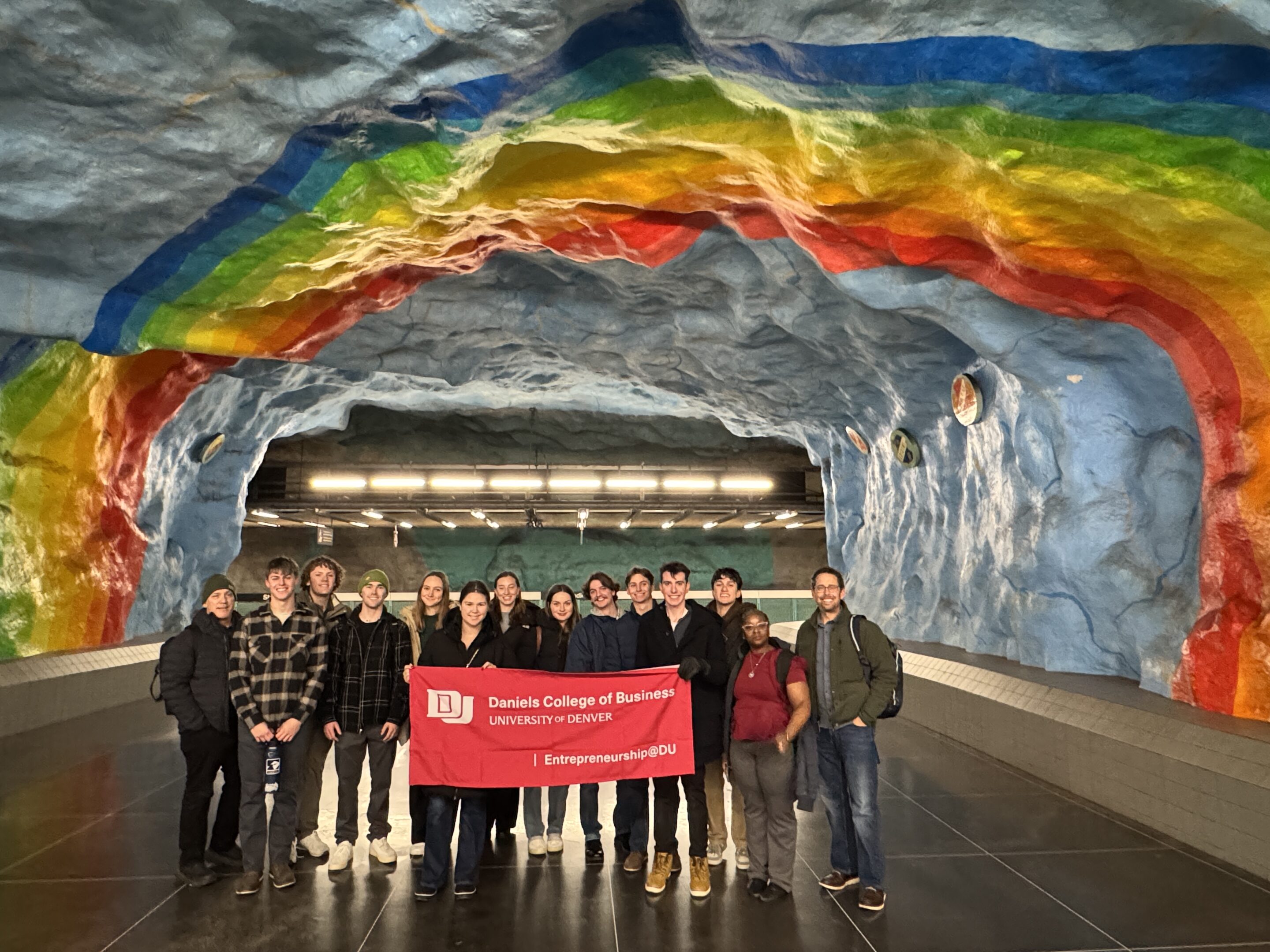 As she jumped into the 32-degree Baltic Sea, 19-year-old Emma Caldwell felt a familiar twinge—not unlike the mix of trepidation and excitement she felt while contemplating Entrepreneurship@DU’s fall 2025 Nordics international interterm course, promoted on a flyer in the library last spring.
Plunging into uncertainty creates fear and carries risks—whether metaphorically in school or business, or literally in an exhilarating moment of adventure abroad. But successful entrepreneurs know that moving through fear unlocks opportunity.
Emerging from the frigid water, steps away from the respite of one of Finland’s three million saunas, Caldwell, a second-year management major at the Daniels College of Business, knew she made the right choice—both to move through her fear of traveling to Europe for the first time, and to partake in a local tradition that surpassed her comfort zone. “It was really cool to actually embrace the culture and get to experience it,” she said, not just learn about it in class.”
E@DU’s intensive travel course to Sweden and Finland took place Nov. 30-Dec. 7, 2025, designed to teach a small group of students about the two Nordic countries’ different startup cultures through immersive, first-hand experience. To make it as authentic as possible experience, Joshua Ross, E@DU’s director at the time, tapped Daniels alumnus, adjunct professor and entrepreneur-in-residence Bill Powell (IMBA 2005, MS 2008) to design the itinerary and co-lead the trip.
Powell, an early-stage investor and entrepreneur, lived in Europe for years, many of which were spent in Stockholm—Sweden’s startup community. Throughout his career, he has engaged with Swedish and Finnish founders, entrepreneurs, accelerators, universities and investors. He said many of these innovation stakeholders “were generous enough with their time to welcome and educate the delegation from Daniels.”
To fully understand the story of Swedish and Finnish work-life culture, the course needed to cover everything from local economies, history, higher education, governmental policy and social support structures to startup business operations. Powell said he crafted an itinerary of visits, excursions and panel discussions to help students understand “the basic rule of law, how society is built, what those underpinnings are, and then the innovation side all the way into the practical side in actual cases and companies.”
Swedish and Finnish startup communities revolve around vastly different cultural values and socioeconomic structures than the U.S., Ross and Powell explained, such as like work-life balance, paid parental/family leave and opportunities to scale.
“I think sometimes we tend to glorify a certain version of startup culture that’s probably untenable and unhealthy,” Powell said. “There’s no glorification of somebody burning out and becoming bankrupt and ill because they took a startup risk.”
While the Nordic countries offer an astounding amount of government-funded leave for new parents (16 months per child in Sweden and 13 months per child in Finland), extensive leaves of absence also place stress on small-scale startup companies to backfill talent, Ross said.
And when it comes to scalability, many Nordic companies look to enter the U.S. to scale their businesses, with Powell noting the GDP limitations of smaller population sizes and geographic footprints.
“You can build a company that scales across the U.S., and with 347 million people, that’s a lot. It’s hard to do that in a country of 10 million people like Sweden or five million in Finland. They have to be global and more external to grow,” he explained.
 Students got the chance to learn these concepts through visits with the Stockholm Chamber of Commerce, KTH Royal Institute of Technology, Sweden’s innovation agency Vinnova, Aalto University, IQM Quantum computing, and two biotechnology companies—Avenue Biosciences, which advances life-science research, and Onego Bio, which is innovating alternative protein sources for food.
Ross tasked students with researching and delivering impromptu mini lessons on each company or cultural/governmental system to better lock in the class’s learning.
The group also toured landmarks like Parliament House and the Nobel Prize Museum, and concluded the trip with that epic Finnish sauna experience and cold plunge in the icy Baltic Sea.
“We had exceptional students,” Powell said. “All you can do is give them the opportunity, but the success of the trip is based on how the students actively engage. They dug in, they showed up prepared and open-minded, asked great questions, and lived up to Daniels’ eponymous namesake of value-based leadership.”
The course was open to all DU students from any level and area of study. Students included Caldwell and another second-year undergraduate student, several fourth-year students, a graduate student from the Josef Korbel School of Global and Public Affairs, and a Daniels Executive PhD student. Caldwell said not knowing the faculty members or any of the older, more experienced students in the group also heightened her anxiety, but that participants “instantly clicked the first day” and Ross and Powell’s engagement throughout the “thoroughly planned and organized trip” helped her feel more at ease.
“Going into the trip, I was so stressed out, but reflecting on it now, I can’t imagine if I didn’t go,” she said. “I’m so thankful that I did end up going. This trip helped me feel much more prepared and ready to attend study abroad in Barcelona, Spain, next fall.”