

 Entrepreneurship@DU BASE Camp accelerator helps student and alumni startups take off during summer break
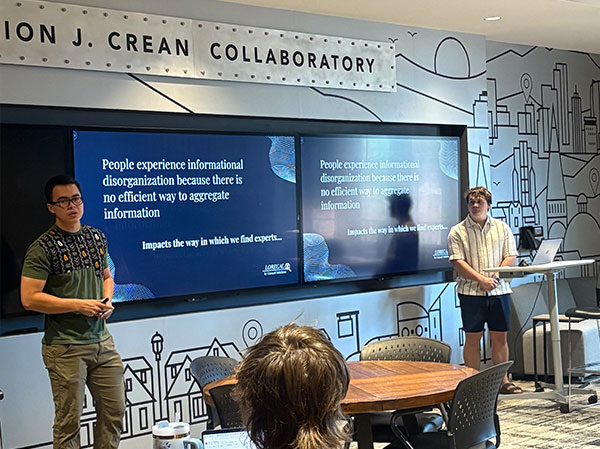
On a sweltering early August afternoon, the University of Denver’s Daniels College of Business was (mostly) a ghost town as students and faculty enjoyed their final month of summer vacation. But, up in the building’s third-floor Franklin L. Burns School of Real Estate and Construction Management Marion J. Crean Collaboratory, four startups, three faculty members and one industry guest were hard at work.
With Entrepreneurship@DU’s BASE Camp accelerator in full swing, there wasn’t a moment to spare—not even for the members of Cohort 4 to grab a cold drink with friends, unless it was directly tied to market research and scheduled into that week’s business plan.
We introduced the 2025 cohort and their ventures in May. The teams began working in June, and the five-week, in-person intensive program began July 25.
By early August, four of the initial six teams were still standing in the rigorous summer business startup accelerator. Teams spent between 16 and 24 hours each week learning new concepts and then immediately applying them through planning, testing and refining their new business ventures.
So, what exactly did the two alumni and two student startups learn this summer?
Prioritization, time management, attention to detail, increasing efficiency with AI, pitching with confidence, sales, funding, market segmentation, product development—and countless other things. Here’s what that looked like, week by week:
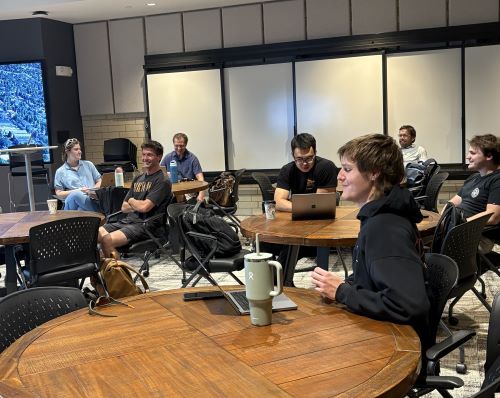
Entrepreneurs taking part in Base Camp 2025
Week 1
Teams delivered their preliminary elevator and investor pitches, examined the problem or opportunity fueling their venture, learned how to validate (or debunk) their assumptions through primary and secondary research, and honed their target markets using advanced customer segmentation. This involved going out into the field to talk to real people from their target markets to learn as much about their problem as possible.
Week 2
Participants applied what they learned about the art of storytelling from guest speaker Dan Cohen into revised elevator and investor pitches, then practiced those pitches with the help of Daniels’ director of multimedia operations Patrick Orr inside E@DU’s brand new Media Studio.
They made meaningful use of the data from their research, workshopped how to test their product and learned to effectively manage their $5,000 BASE Camp budgets. Then, they presented their plans for testing their product fit in the market with prototype experiments and customer validation methodologies.
In that Wednesday afternoon meeting in The Collaboratory, BASE Camp facilitators Joshua Ross, Alisa Chalakhyan and John Sebesta, together with guest Loron Orris, lent seasoned advice on how teams could improve their strategies and refine their pitches.
They empathetically yet assertively pointed out participants’ blind spots and thinking errors, offering afterhours mentoring to help some get back on track. After all, BASE Camp isn’t a long, drawn-out class with a final exam to cram for at the end. It’s a fast-paced, continuous commitment with condensed, accelerated content—and one giant, real-life experiential ‘class project’ requiring focused dedication, critical thinking and the ability to pivot on a dime.
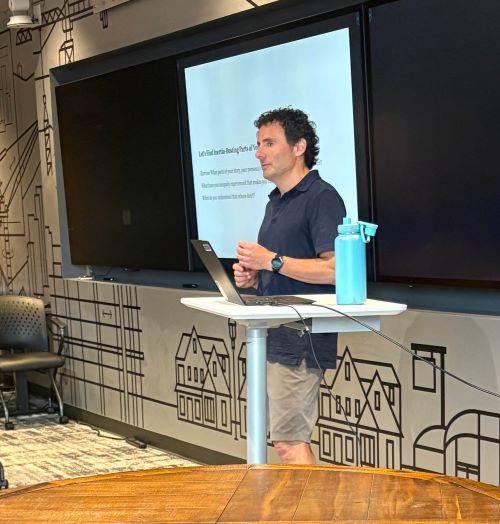
Guest speaker Dan Cohen
In their week two presentations, teams laid out detailed plans for their weekend. Top on the list: Cold calling leads while doing their laundry; quickly building, then launching website landing pages and paid social media ads to test conversions; and going out for that cold drink—not out of leisure, but rather a calculated move to network and pitch prospective customers where they hang out.
Week 3
Halfway through the summer intensive, BASE Campers worked on tailoring their brand messaging for specific channels, promotions and audiences, with a focus on digital assets and platforms. They learned the full sales process from initial contact to closing a deal with a compelling sales pitch.
Every week of the program, startups presented their upcoming plans, KPIs and progress to-date, allowing fellow BASE Camp participants to share in the learnings.
Week 4
At the time of publication, startups are currently developing their ‘go to market’ strategies. They are slated to round out the rest of week four with a half-day brand and messaging session by Goodlove Foods founder Chenelle Diong (MBA 2022), as well as an offsite visit to Access Mode—a “values-driven organization focused on high-touch mentoring that removes barriers to successful startups for Black, Latino, Asian American and Pacific Islander, and Indigenous tech founders.” These are just two examples of immersive learning sessions the startup teams will have with 20 leading industry experts this summer.
Week 5
In their final week, teams will learn about funding their businesses, legal and intellectual property, and the importance of emotional intelligence, resilience and grit for success in business and life.
The 2025 BASE Camp accelerator will conclude with The Final Pitch from 2:30–5 p.m. on Aug. 28, at the Daniels College of Business.
All are welcome and encouraged to attend this inspiring event to hear teams’ final pitches and celebrate their journey with a reception in the Hub—E@DU’s new space for collaboration, creativity and innovation. Register here for the event, which includes free parking, snacks and beverages. Stay tuned for a recap of Cohort 4’s progress and accomplishments in E@DU’s September newsletter.