

How Ashley Bremers’ intricate career path and Daniels EMBA led her exactly where she was meant to be
For Ashley Bremers (EMBA 2026), the corporate ladder is a myth. It’s never been how she’s viewed her career.
“I’m a perfect example of how a successful career can be a jungle gym rather than a ladder,” Bremers said with a chuckle, describing a journey that has taken her from cancer research labs to restaurant kitchens, from spacecraft factories to the frontier of artificial intelligence.
Her stops weren’t about climbing. She was exploring—swinging sideways, reaching across industries, following opportunity and her curiosity. But it wasn’t until Bremers entered the Executive MBA program at the Daniels College of Business that she began to see the full pattern in her path.
Bremers grew up in Boulder, Colorado, graduated from the University of Colorado with a degree in biochemistry, and worked in cancer-related research at a university lab. But the lure of adventure drew her and her boyfriend, a musician, to Los Angeles. The plan was graduate school. What happened was restaurants—opening and running them across California, then in Boulder and Denver.
“I learned the magnitude of prioritizing customers—letting customers lead you—but I missed using that more analytical side of my brain,” Bremers said. So she pivoted again, returning to CU to pursue a PhD in mechanical engineering with an emphasis in materials science.
Halfway through, Bremers realized she was too extroverted for doctoral life. She left the program, but in doing so, she swung to another bar. Her professor was launching a battery manufacturing startup and needed someone with technical know-how and business sense. She became Solid Power Battery’s first employee, helping secure multimillion-dollar Department of Energy research awards.
More tech startups followed, along with a deliberate detour through Whole Foods’ meat department—which meant good benefits and time to pursue leadership certifications. Then came a jump back into the corporate world at Thomson Reuters.
There, Bremers found her calling: business transformation and organizational change management—the craft of helping large, complex organizations adapt to new technology and new ways of thinking about their business.
Bremers also held business transformation roles at UnitedHealth Group and MD Anderson Cancer Center. Then came a call from Sierra Space, a builder of satellites and spaceplanes back in Boulder, which shot her career into the AI universe.
But throughout her professional growth, a quiet doubt lingered. She had built her expertise unconventionally, crossing industries and learning on the fly. Well-meaning mentors told her she didn’t need an MBA. “You already know this stuff,” they said. Yet that was the issue.
“I always questioned myself,” said Bremers. “I didn’t know whether it was because I was uncertain about how things worked or because I didn’t know the language.”
She wasn’t lacking knowledge so much as context—and confidence.
Auspiciously, her brother, Austin Bremers (EMBA 2025), had enrolled in Daniels’ Executive MBA program and pestered her until she sat in on a Saturday morning class. Within an hour, she texted her boss—the former SpaceX CIO—to share ideas sparked by the session.
His response: “We need this. Get in there.” She did. What followed was less a traditional education than a rolling validation.
“With each class, it grew,” Bremers said, describing the confidence that had been hiding inside her.
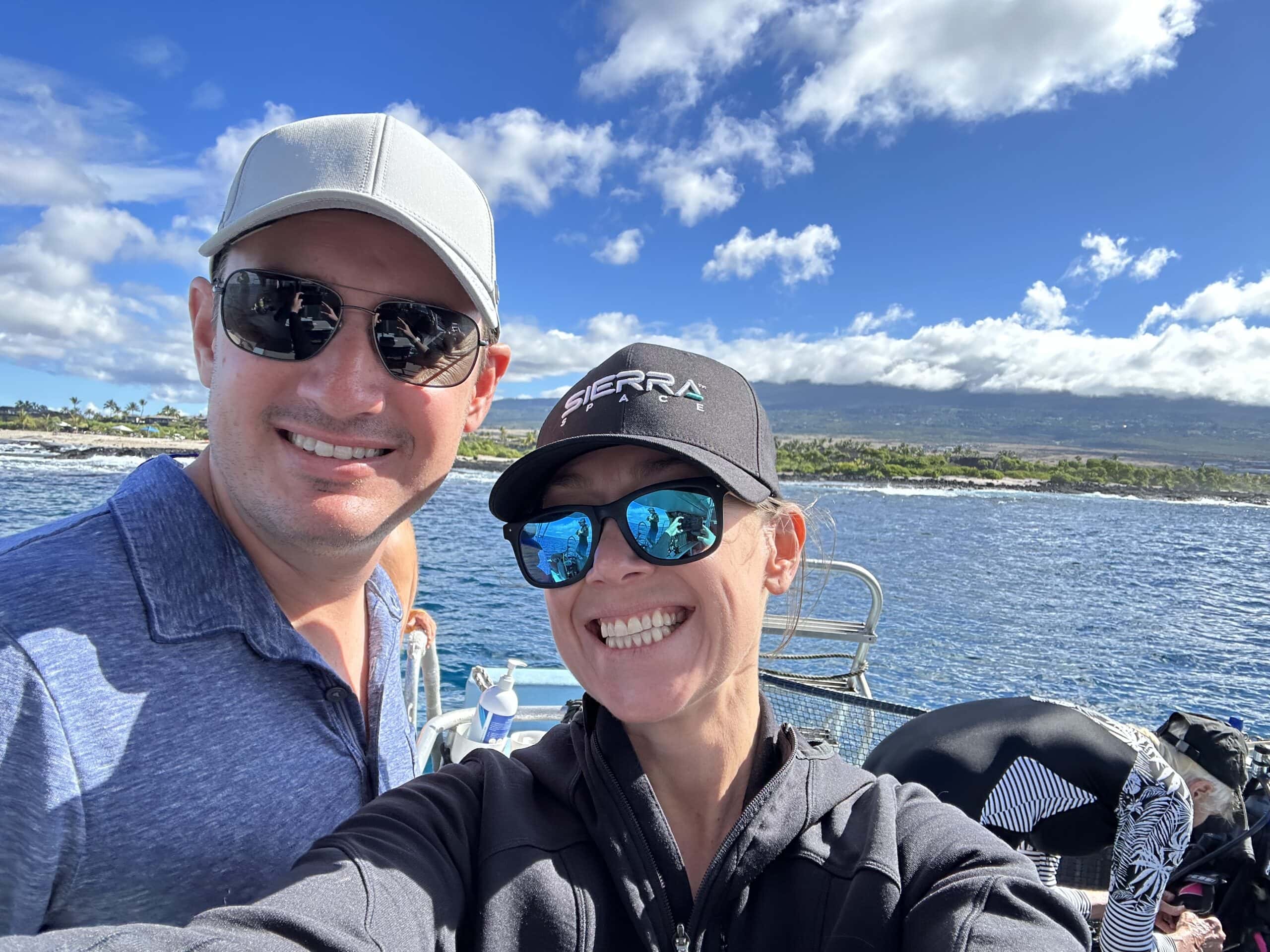
Ashley Bremers and her brother, Austin (EMBA 2025).
Balance sheets snapped into focus. Financial language she’d been navigating intuitively took on meaning and structure. But Bremers’ cohort’s trip to Ulaanbaatar, Mongolia and Seoul, South Korea, to study the feasibility of building data centers to support the AI wave, proved to be the real inflection point.
After meetings with businesses and time spent with cohort members, she had a realization that stopped her cold: Countries are just organizations with different business models.
In that moment, the systems thinking she’d practiced throughout much of her career—the ability to see organizations as a whole and to consider people, process, technology, data and governance together—revealed its true scale.
“I realized that my ability to think systematically—the big picture, across disciplines—applies at any scale,” said Bremers. “At that moment, I realized my value—which is understanding a business like a CEO—and that I get to choose what I want to do.”
Bremers left corporate life soon after returning from the trip and launched a consulting firm, becoming her own CEO. Within months, she connected with Nick Machol, CEO of Unburdn, an AI education company, and chair of the Daniels Executive Advisory Board. Machol helped her understand that her background was ideal for helping his customers’ companies harness AI’s transformative power.
Today, Bremers serves as Unburdn’s AI Partner Lead, serving as a fractional chief AI officer for companies navigating the bewildering AI landscape. Whether the client is a global powerhouse or a local mechanic, the approach remains the same: start with education, understand the people and the processes, and deliver what Machol calls “a 14 out of 10 on everything that we do”—the laser focus on customers Bremers learned in the restaurant business.
It’s the jungle gym in action. Up, across, down and up again—each bar a different discipline, each swing a deliberate choice. The perfect place, and the ladder was never the point.