

Daniels MBA students worked inside Boost Mobile to develop a customer loyalty solution that influenced senior leaders and challenged industry norms.
 You know the drill. Your phone’s getting old, maybe it has a broken screen, so you amble into a wireless store and swagger out with a shiny “free” upgrade. Only it isn’t entirely free because your monthly rate plan crept up by a few dollars. Repeat every two or three years.
Boost Mobile, a brand under EchoStar Corporation, set out to break that cycle. To help, it handed the problem to five Daniels MBA students.
That’s the Corporate Challenge—a component of the full-time Denver MBA program that integrates student teams into industry settings to tackle real-world business problems. The messy kind that don’t have textbook answers.
Boost’s qualified. The company wanted to rethink how to keep its seven million subscribers loyal without relying on the same upgrade/retention playbook used by the Big Three wireless providers.
“We treated the students like employees. … What impressed us most wasn’t just the big ideas, it was the rigor behind them.
The challenge
“There had to be a different way,” said Robert White, Boost’s senior vice president of retail wireless operations and loyalty. “It wasn’t sustainable. It wasn’t fair to customers.”
So Boost challenged the students—who, as White said, “knew nothing about wireless other than their own cell phones”—to think differently.
But Boost did something unusual for most university business programs: It let students all the way in. Rather than distance them from the company’s industry knowledge and proprietary data, White issued each student a Boost laptop. Plugged into the company’s systems, they had access to shared drives, team chat, direct lines of communication to Boost’s analysts, and reams of data on churn, upgrades and device costs.
“We treated the students like employees,” he said. “They had full access to my team and even pinged them late at night and over weekends. Their timeline was short, and it got them much farther downfield, faster.
“In the end, they had a lot of unique elements—things we hadn’t considered,” White added. “What impressed us most wasn’t just the big ideas, it was the rigor behind them. They went deep.”
The team
That depth came from the distinct strengths of the five students, matched by adjunct faculty advisor Ann Koerner, who supported the team of first-years throughout the project.
Ryan Koning engineered the financials and created a break-even calculator so precise that when executives asked what a different profit margin would look like, the team just plugged in the number. Gabrielle Kellogg designed a full app prototype, complete with an AI helper. Alia Gant led the team’s research and served as communications liaison with Boost. Tyler Shaffer-Colvin drove creative ideation and much of the face-to-face work with Boost that shaped the concept. And Amity Christie ran point as project manager, keeping deliverables on schedule and balancing the project against a full course load.
The work
The team started by analyzing Boost’s business—studying its existing telephone subsidy and retention model, then meeting with the company’s value-added services, finance and loyalty teams to learn how things operated and where they could work better.
Then came the research: benchmarking loyalty programs they admired—Starbucks, several airlines—analyzing customer behavior and profitability, challenging one another’s ideas, building the financial model, and iterating on feedback right up to the final presentation.
We were able to influence decision-makers. It wasn’t a theoretical university consulting project. We feel like we made a real difference.
“One of the most valuable parts of the experience was the process of getting there, working through an ambiguous problem, applying concepts from our MBA classes, researching and testing different ideas, incorporating feedback, and ultimately turning five different perspectives into one cohesive recommendation,” Christie said.
For the first time, the Corporate Challenge paired a team with an outside advisor, Brant Torres, senior consultant in design innovation at Slalom Consulting.
“Brant challenged us to think beyond the surface level,” Christie added, “He helped us flesh out our ideas further.”
The outcome
What emerged was not another rewards program, but an entirely new branded device-upgrade ecosystem designed to replace the traditional subsidy model.
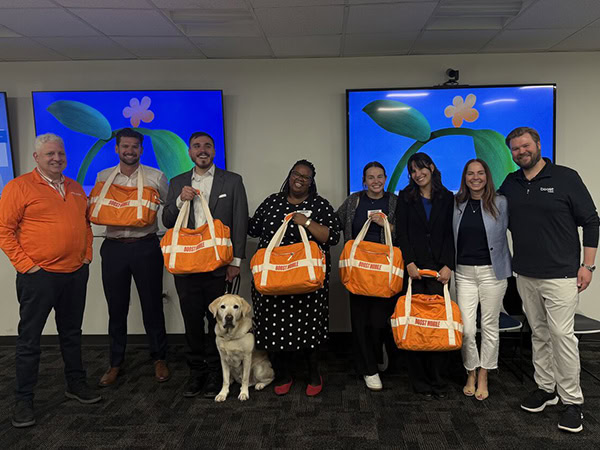
The team delivered its final pitch to White, EchoStar’s President and COO, its chief HR officer and 15 or so senior leaders, all of whom praised their work.
“They did a really nice job,” White said. “Their approach was data-driven and thoughtful, and they built a social structure around the program to engage the base in a new way. It was a great partnership—and we’re looking forward to doing more of these with Daniels.”
“Their leadership was very pleased,” Christie echoed. “But more important for us was that we were able to influence decision-makers. It wasn’t a theoretical university consulting project. We feel like we made a real difference.”
Not bad for a team that started out knowing nothing about wireless—except that everybody has a phone.