

The quarterly introductory business class concludes with a community showcase and pitch competition for student startups
Since 2012, the University of Denver’s Entrepreneurship@DU has hosted a quarterly challenge for undergraduate students to showcase the impressive innovations created in Daniels’ “Fourth Industrial Revolution” introductory business class. This fall, the ladies took the cake (and the cash prizes).
On Wednesday, Nov. 12, more than 200 DU community members—students, faculty, staff, alumni, parents and local business professionals—gathered inside the University’s Community Commons to check out the student teams’ creative use of technology.
It started with a science fair-style exhibition, where attendees and judges got an up-close look at some seriously ingenious tech innovations. E@DU faculty members had the arduous task of selecting the 26 student startup businesses to showcase their ideas at the 4Impact Challenge from 90 (yes, 90) initial team pitches.
That group moved on to face a judging panel of entrepreneurial and business professionals, which featured April Archer (founder and CEO of Sara Bella Fishing), Samantha Monson (founder of We Hate Exercise), Derek Pilling (founder and advisor at Workhorse Capital) and Eric Schneider (founder and CEO of Cora). They evaluated each semifinalist’s successful use of fourth industrial revolution technology—artificial intelligence, internet of things, neurotech, virtual reality, quantum computing and more—to solve real problems that help real people.
Six student teams would pitch their ideas as finalists, in front of a crowd seated in the Community Commons and watching online via livestream. Finalists weren’t revealed in advance. Instead, the 26 teams anxiously listened for their names, hoping to be called to the stage to pitch.
Six groups earned the chance to grab a mic and give a five-minute presentation on the who, what, when, why, where and how of their problem, opportunity, target market and solution. The teams that came out on top delivered engaging pitches that outlined realistic solutions to clearly defined consumer problems and used two or more fourth industrial revolution technologies to serve research-supported target markets.
Before the winning teams were announced, two surprise judges presented special category awards to three additional student startups from the “science fair” exhibit, recognizing the most impactful idea, best booth display and best use of fourth industrial revolution technology.
In the final round, all-female teams took home first-, second- and third-place cash prizes, along with medals that were custom-designed and 3D printed by teaching assistants in E@DU’s new Create Studio.
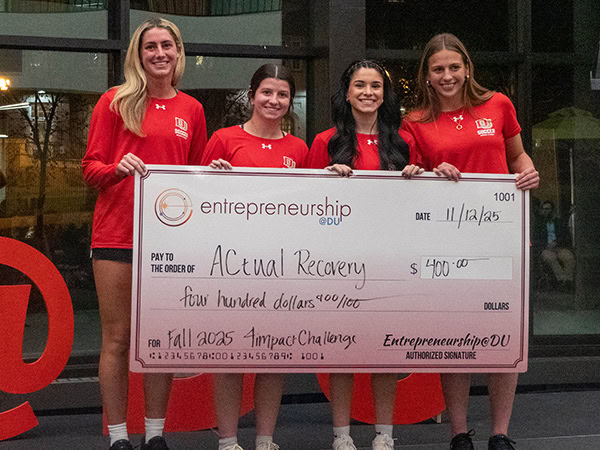 ACtuaL Recovery, an app that integrates with a smart knee brace to support more efficient ACL recovery in student athletes, earned third place and $100 for each team member.
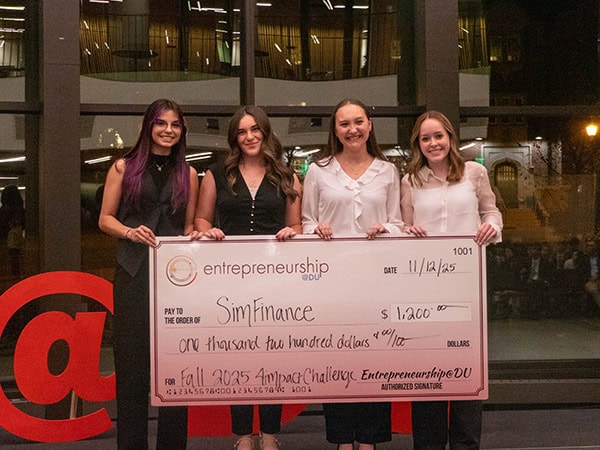
Second place (and $300 for each teammate) went to SimFinance—a next-gen financial literacy app that uses digital AI twins in a simulated online environment to teach young people how to manage their personal finances.
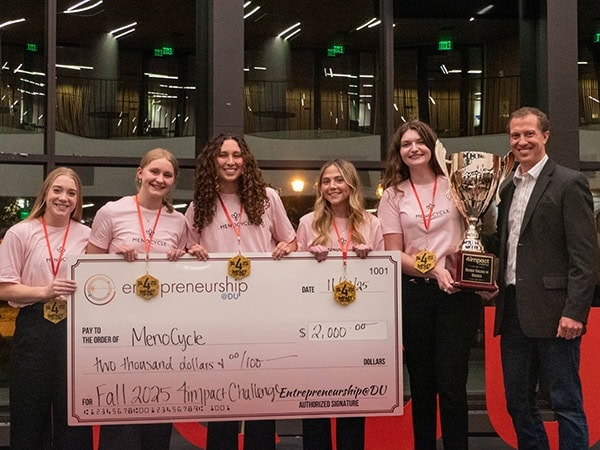
MenoCycle came in first, earning each team member $500. Inspired by the struggles of second-year student Julia Saxman’s mother, who was seeking relief from menopausal symptoms, MenoCycle connects a continuous hormone-monitoring, minimally invasive medical patch with an AI diagnostic app, delivering personalized health care support to patients experiencing hot flashes, insomnia, weight gain and dozens of other unpleasant symptoms.
According to the team, “70% of women report receiving no guidance on navigating menopause from their medical practitioners and 80% of OBGYNs are not adequately trained to treat menopause.”
MenoCycle is the brainwork of Saxman, third-year biochemistry major Amanda Hargraves and first-year business students Isabella Cardenas, Anabelle Harris and Amelia Schwartz. With a target market of 45-60-year-old women, MenoCycle taps into the growing trend of Gen X and elder Millennials discussing their personal experiences with aging-related reproductive health issues on social media—breaking the mold of prior generations who historically suffered through “the change” in silence.
MenoCycle has the potential to deliver highly sought-after individualized hormone-replacement therapy to the $13+ billion global menopause market. John Sebesta, an E@DU assistant professor of the practice and Koch Endowed Chair of Entrepreneurship, was MenoCycle’s faculty advisor.
“The team recognized the historic lack of investment into women’s health care needs and identified a prevalent issue which aligned with the skills and passions of the group,” he said. “They didn’t shy away from a potentially taboo topic and instead used that in a playful way to emphasize the need to open up the conversation.”
Sebesta said the team excelled by “digging deep into the technology to ensure they were proposing a truly viable solution” and “committing to performing their best while maintaining the humility to learn, grow and refine their public-good business concept.”
Indeed, MenoCycle embodies Gen Z’s telltale trait—high empathy with a desire to solve problems that supersede personal gain.
“This isn’t just a personal struggle; this is a massive unmet market opportunity,” the team said during its pitch. “Women today demand better, smarter, more personalized health care treatments to help them navigate through this stage of life. And they deserve it. That’s where we come in.”
In their final remarks, the judges commended all teams for their courage, success and drive to make the world a better place.
“The world is in really good hands with brilliant minds like yours,” Monson said. Archer also reminded students that this course and competition are not the norm in all business schools, but rather a unique experience and valuable opportunity to gain real-life entrepreneurial skills.
“You’ve learned to overcome your nerves, your fears, to present, to work in teams, to do research, to innovate, collaborate, take risks, and sometimes to fail, and that’s okay,” she said. “I, too, am feeling inspired and full of hope to see what you all might do in the future.”