

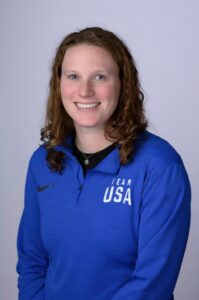
Emily Lloyd Brauer
When the Olympic cauldron is finally lit, Emily Lloyd Brauer’s job gets—temporarily—a little easier. As a performance pathways manager at the U.S. Olympic and Paralympic Committee (USOPC), the 10 days leading up to the Games are a sprint.
Brauer spends much of her time fostering partnership between the USOPC, the NCAA and individual colleges. She keeps track of college athletes and programs, making operational recommendations that will mutually benefit those athletes, their respective schools and Team USA. When the Olympic and Paralympic Games come around, Brauer and her team work hard to funnel collegiate data and storylines to the media covering the Games.
It’s a world Brauer knows well. She was a six-time All-American swimmer and six-time ACC conference champion at the University of Virginia. She qualified for the Olympic Trials in 2008 and 2012.
She came to the Daniels College of Business in 2021 to pursue an MBA. Simultaneously, she served as an assistant coach for the University of Denver’s men’s and women’s swimming and diving teams.
After stopping by campus for a lunch and learn event with Daniels grad students, Brauer answered a few questions from the Daniels Newsroom about her role and her experience attending the 2024 Paralympic Games in Paris.
What happens in the 10 days leading up to the Games that makes it so busy?
There’s not much time between when the full U.S. roster is announced and when the Games begin, so one of the key things that our team does is research those qualified athletes’ collegiate ties—where they went to school and if they competed collegiately. We build out infographics that summarize key data points, for example that nearly 40% of the U.S. Winter Olympic Team competed in college, including 90% of both men’s and women’s ice hockey teams and 93% of the bobsled team.
Does that take a lot of digging up to do?
Sometimes yes. Sometimes no. The Summer Olympic side is a little easier because most athletes competed collegiately in the same sport in which they are representing Team USA. For example, you can Google “Emily Lloyd, Virginia swimming” and find a roster with all the information you need. On the winter side, there is more talent transfer—athletes who competed collegiately in track and field and then found a sport like bobsled after they finished their collegiate career, so it sometimes takes a bit more research. Additionally, on the winter side, we track athletes who attended college, even if they did not compete for their school. For example, many winter sport athletes live and train in Park City while taking classes at Salt Lake Community College or the University of Utah.
How has this job shaped the way that you look at the Olympic and Paralympic Games?
I would say that I have a lot more consideration for all the work that goes into it. I now hear what Mike Tirico says during a broadcast and think, “Oh, that story came from somewhere and a lot of people had to work on it.” My understanding has shifted and I just pay more attention.
What’s something that people don’t realize about an athlete’s journey from college to the Olympics?
I think what a lot of people don’t realize is how dependent a lot of Olympic and Paralympic sports are on the NCAA system. Even the Paralympic movement actually is pretty dependent on the NCAA varsity system within specific sport classifications. There are Para athletes competing on NCAA varsity teams across the country who are able to train and compete with their able-bodied peers, and then also get the opportunity to represent their country and compete in the Paralympic Games.
So, on both the Olympic and Paralympic side, the collegiate system is a huge part of the pathway to Team USA. At the most recent summer Games in Paris, 75% of the U.S. Olympic Team and 53% of the U.S. Paralympic Team competed collegiately. NCAA Division I schools in particular invest over $5 billion every year in their Olympic sports programs that produce many of the athletes who end up making Team USA.
You were really qualified on paper for this job: a former coach, a former athlete, swimming in the U.S. Olympic trials. What did you learn in a Daniels business program that rounded out what you needed for this job?
I think the general business understanding that I got here—how to speak the language of finance, for example—was something that I didn’t have before. It’s not that I work in finance at the USOPC. I don’t need to know how to do the things that I learned in our finance or accounting classes. But understanding those basics in areas I didn’t previously have experience in helped me understand how to make better business decisions.
Also, the experiences that I got through the [in-class] challenges, working as a consultant, having to answer questions and build presentations for external stakeholders—those are the things that I do very often. The skills I learned in school to think strategically, see patterns and make connections across different functional areas are key I think no matter which industry you are in.
Last question: The last time our newsroom profiled you, you were about to go to the 2024 Paralympic Games in Paris. Now that you have been to the Games, what was one of your favorite moments that you got to experience?
[In Paris,] I had a media credential to go into the media mixed zones after competition to take photos of athletes and send them back to their schools, so that their school could celebrate their athlete competing in the Games.
The coolest moments were just that. The Olympic Games and the Paralympic Games are these huge opportunities that the athletes have worked so hard for. So it was amazing to see how just handing them a pennant of their college brought them so much joy and connection to their collegiate home.