

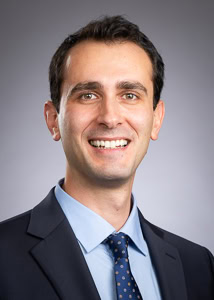
Each week, Daniels is featuring a researcher who conducts meaningful research that impacts their field and the wider community. Learn more about their work in Q&As with the Daniels Research team and email them to nominate yourself or a colleague for a future Q&A.
Orkun Baycik is an assistant professor of business information and analytics in the Daniels College of Business at the University of Denver. His research and teaching interests lie at the intersection of analytics, operations and supply chain management with studies focusing on both business and societal problems. His research applications include modeling and disrupting illegal drug trafficking and illegal fishing supply chains, improving sustainability in the apparel industry, and evaluating government initiatives aimed at ending homelessness.
What do you study and why?
I describe myself as an optimization and machine learning researcher. In simple terms, I develop models and algorithms that help organizations and decision-makers make the best possible decisions as quickly as possible. I’ve always been fascinated by the process of taking a real-world problem, translating it into a mathematical model, identifying its constraints and then designing a strategy to improve outcomes.
My academic background is in industrial and systems engineering, which I see as a more technical version of business analytics. That background naturally led me into studying complex systems—from legal supply chains to criminal networks—where the ability to optimize decisions can have a real impact on both business performance and societal wellbeing.
During my PhD at Rensselaer Polytechnic Institute, I became interested in the challenge of modeling illicit systems—specifically, illegal drug trafficking networks. These networks are incredibly dynamic: actors move, disappear, or get replaced, and the system constantly adapts. Trying to model that complexity was intellectually fascinating, but it also had a larger purpose—helping governments and law enforcement agencies make more informed, effective decisions.
Over time, my research has expanded to other types of illegal supply chains, including illegal, unreported and unregulated (IUU) fishing. This work connects global economic, environmental and human rights issues, making it both analytically challenging and socially meaningful. I’ve also applied similar modeling approaches to topics such as apparel waste reduction and homelessness, where the goal is to help organizations operate more efficiently and responsibly.
How do you involve students in your research?
I love involving students in my research because it allows them to see how the tools they’re learning in class apply to real problems. Many of my projects begin in the classroom, where I use my own research as examples in regression or optimization lectures. Students often reach out afterward, asking to collaborate.
For example, one of my former MSBA students helped develop an optimization model for apparel supply chains to measure how design changes could reduce waste. Another student worked on homelessness research, building a regression model in Python to evaluate policy outcomes. These collaborations not only enhance the research but also give students valuable experience applying analytics for social good.
How does your work connect to broader impact?
Whether I’m studying criminal networks or consumer supply chains, my ultimate goal is to generate insights that improve lives. I’ve worked with government agencies and nonprofits that often struggle with collecting or analyzing data. By connecting with them—and by involving students in that process—I hope to help bridge that gap and empower these organizations to make evidence-based decisions.
I’m also interested in expanding partnerships here in Denver and across Colorado. Many local nonprofits could benefit from analytics-driven insights, and I see tremendous potential for student-led research that contributes directly to the community.
What are you most excited about next?
I’m excited about continuing to develop analytics-based approaches to some of society’s most complex challenges. My colleagues and I have a paper under review on illegal fishing networks, and we’re already planning next steps to expand that work. I’m also eager to deepen community and government partnerships so that our models and insights move beyond the academic realm and into practical application.
I’m currently working on several projects that connect analytics and social impact. One project uses machine learning to predict criminal behavior within illegal networks, helping identify potential traffickers or manufacturers based on limited data. Another project models apparel supply chains to find ways to reduce waste in the fast fashion industry by rethinking how materials and resources flow.
I’m also studying homelessness and the effectiveness of permanent supportive housing programs—using data to determine whether these initiatives are actually reducing homelessness. Across all these projects, the common thread is applying advanced analytics to create real-world improvements. At its core, my research is about using data and optimization to make a real difference—whether that means improving sustainability, supporting policy decisions, or strengthening communities.