

Education at the Extremes
A two-week global trip teaches Executive MBA students skills, confidence and perspective in the most unfamiliar of places
Story and photos by Lorne Fultonberg
Cameras are not allowed inside the special banquet space at the Ankole Grill Kitisuru in Nairobi, Kenya.
Though the students in Executive MBA Cohort 82 have filled their phones with close-up photos of drones delivering medical supplies, bridges that connect communities, unfamiliar landscapes and safari animals—this moment will have to live in their memories.
For two weeks now, these 11 Daniels College of Business students have been on a jarring, unpredictable journey through Rwanda and Kenya—two countries with vastly different histories, cultures, political systems and economies.
They have acquainted themselves through a jam-packed itinerary, rife with visits to local companies, cultural touchpoints and once-in-a-lifetime experiences.
At this farewell dinner, the students are trying to find the words to describe it. One by one, they rise from their seats around a long rectangular table and reflect. Many laugh, some cry, but all express the profound impact the short trip has made on their lives.
“One thing that I’ve been struggling with is what’s next,” says Robert Nanney, a student who is set to retire from a lifetime in law enforcement. “That’s been a very hard challenge for me. It’s kind of this black abyss. A lot of the meetings this week really impressed upon me that there are many companies out there that really do put public good before profit. Profit, of course, is necessary to keep the wheels turning, but that drive to do something great and bigger is something that I need.”
“We want to be where the world is headed, rather than where the world has been.”
What can I learn from an emerging economy?
~Amanda Cahal, Director of MBA Global Programs
These are not the reflections that typically come from business trips to London, Milan or Dubai. But they are the way nearly all Daniels Executive MBA students feel after pushing their comfort zones in the Global Business I and II class—where the world’s largest markets won’t be found on the list of 30 potential international destinations.
“When it comes to these international experiences, the learning happens at the extremes,” says Amanda Cahal, the director of MBA global programs and one of three faculty co-teaching this course. “Much of the world’s growth is in emerging markets and developing economies. We want to be where the world is headed, rather than where the world has been. If our students can build the openness, curiosity and adaptability required to do business in those markets successfully, they can do business anywhere.”
In the months leading up to the trip, the students researched what it might take to start a successful business venture in Rwanda and Kenya—and devised an idea they could pitch. Once they set foot on east African soil, they hit the ground, arranging their own meetings with companies, nonprofits and government agencies to inform their feasibility study.
By the time their trip ended, students gained a deep understanding of what it takes to do business in another country. Because they have not only studied it—they have lived it.
What Makes the Daniels Global Experience Different?
THE LOCATIONS
Executive MBA students choose their destinations from a list of 30 countries, many of which would be considered “off the beaten path.” They are instructed to pick two nations with vastly different cultures, politics, histories and economic growth.
THE DANIELS NETWORK
The trip is built around the robust Daniels alumni network and international relationships that have been developed for decades. The connections students and faculty make on the trip perpetuate and lead to new partnerships in the future.
A TEAM-TEACHING APPROACH
The Global Business course is led by an experienced, skilled group of faculty. Their respective professional backgrounds deliver a multifaceted, comprehensive perspective. They co-create the curriculum with the students in class.
“Pack Your Patience”
“Remember when you were a kid, and your parents were going to take you to Disneyland?
“And you couldn’t sleep the night before because you were so excited?”
Kerry Plemmons, a professor of the practice, looks around the classroom.
“That’s how I feel now.”
It’s April 12, 2025, the start of the spring term, and the first of seven in-person sessions to prepare students for their global trip—a journey nearly always described as the most memorable and impactful part of the EMBA program.
Ultimately, students will break into small groups and take on the course’s main assignment: creating a three-stage feasibility study that analyzes an idea for a business to enter a new market or reduce costs in an existing market.
The extensive research they perform over the course of the quarter is intended to both inform their study and mentally prepare them for what they are about to experience.
EMBA students have generally been in a position of leadership for more than a decade, says Jenny Dobmeier, the EMBA executive director and co-teacher of the Global Business course. They are used to being in control. This trip will require them to get comfortable with the uncomfortable.
As a reminder, Cahal has written three letters on the whiteboard: TAB, an acronym for “That’s Africa, baby.” It’s a lighthearted mantra faculty and students can use to describe the excitement of new discovery, or the frustration that can come with cultural differences. Dobmeier tacks on a few words, based on her international experiences: “Pack Your Patience.” Interpersonal interactions, expectations of timeliness and deadlines may not be the same as what the students are accustomed to.
MBA classes at other universities are not like this, Dobmeier says. The faculty look to their experienced students to co-create their curriculum. As a result, Global Business I and II is also a self-audit of each student’s beliefs—everything they thought they understood about the way business was done in other countries.
“The Daniels College of Business has a persona, and part of that persona is the confidence to do global business,” Plemmons says. “We can’t be worldly thinkers unless we know what’s going on in the rest of the world.”
What is a Feasibility Study?
The Global Business I and II courses culminate in a feasibility study where students apply EMBA skills to global challenges. Over 15 weeks, three teams will develop a market or cost-reduction study that follows a three-stage “Stage Gate Process” to determine a go/no-go decision.
- Stage 1 involves ideation, where teams formulate a business concept, problem or opportunity and create a decision matrix to assess feasibility.
- Stage 2 focuses on secondary research against this matrix.
- Stage 3 is dedicated to on-the-ground primary research in Rwanda and Kenya, validating and refining previous findings. A minimum of one business meeting in each city is required. The final go/no-go decision must be justified by both primary and secondary research, with pivots based on new information obtained during the trip being encouraged.

Part of the Daniels College of Business persona is the confidence to do global business.
How did students choose Rwanda?
~Forrest Hanson, EMBA Cohort 82
Meet the faculty

Kerry Plemmons’ perspective on marketing, the supply chain, the challenges of currency fluctuations and more comes from work at Starbucks and adventures opening restaurants in other countries.

Jenny Dobmeier brings to the table two decades of global business experience as a leader with Johns Manville, working with suppliers across Eastern Europe and customers globally.
Amanda Cahal has spent 25 years building a global network of relationships. She has made 35 trips to the African continent throughout her career at Daniels and with The Carter Center.

DENVER ISTANBUL
MILES
ISTANBUL Kigali
MILES
Why is Africa a Special Destination?
Amanda Cahal began her career monitoring elections in Mozambique and Zimbabwe.
It was a remarkable experience that pulled me into a lifetime of spending time there and falling in love with it all over again. And when you all choose it, it fills my soul. Because you will come back from this trip and my hope is that you will be ambassadors for a really misunderstood part of the world. And that you’ll be ambassadors forever, for these places where most people are asking you if you’re on a mission trip.
RWANDA
Rwanda is a country reborn. In 1994, after a destructive civil war and ruthless genocide, citizens began to pick up the pieces.
The genocide and its aftermath have shaped every aspect of Rwandan society. So, the first thing students do after settling into their hotel is tour the genocide museum and memorial, located in the capital city of Kigali.
The memory of the genocide has created a unified spirit and a commitment to overcoming a dark past. New sky-high scaffolding and a mandatory monthly community cleanup have made “The Land of 1,000 Hills” the second easiest African country to do business in, according to the Rwanda Development Board (RDB).
In an RDB boardroom, the Daniels students listen intently. They may come from the world’s most developed economy, but Rwanda’s “hustle,” innovative spirit and novel approach to development are rewriting their definition of “success.”
“A government that is so disciplined, has clear goals, you can see what level of difference it is making already,” says Padma Rajendran, a student in Cohort 82 who works at the University of Denver. “Here, they know how educated their community is, so they are using their monthly cleanup as a communications channel. That is directly applicable to nonprofit organizations operating on a scale like our university. Having a community engagement like this and making it part of the culture and then talking about your agenda would be great.”

Each student leaves the Rwanda Genocide Memorial with a lapel pin, which they proudly display on every step of their journey. The pins feature the Kinyarwandan word “ubumuntu,” which means “humanity.”
Rwanda’s “hustle,” innovative spirit and novel approach to development are rewriting students’ definition of “success.”
“See It, Experience It, Live It”
Anyone who sees the two-week EMBA excursion as a vacation has clearly not flipped through the itinerary.
Each morning, the bus leaves no later than 8 a.m., destined for 3-4 stops at a wide variety of organizations—spanning an even wider variety of industries. “Company visits” are a cornerstone of the global trip, a valuable chance for students to see ventures with their own eyes and ask whatever questions they’d like.
The visits are the fruit of Cahal’s vast global network. Some are the result of long-standing relationships, others are new additions but all make plain the impact of learning through experience.
A company called Zipline is almost always on the Rwanda itinerary. For weeks, back in Denver, students studied the way Zipline uses drones to quickly deliver blood, medical equipment and supplies to rural communities. They read case studies about how trips that take hours by land can be completed in minutes by air.
But on this day, they can watch Zipline launch some of the 600 drones it deploys daily. They gaze, mesmerized, as other drones make their return to the premises, caught with a thud by a thick wire that captures its momentum and reduces it, so it can be reused.
A packed itinerary of company visits makes plain the impact of learning through experience.
Zipline launches 600 drones every day and catches them when they return.

Zipline transports supplies in under an hour to parts of the country that a car could reach in six or seven hours.
More than half of Zipline’s deliveries are medical supplies, including blood to local hospitals. Drones also deliver food, retail and agriculture products.
Drones drop their payload with a plastic parachute before they make the return trip to the company’s headquarters.
Later, at the Rwanda Trading Company, the cohort can learn about the country’s leading coffee exporter while sipping on a steaming mug of ethically sourced brew.
Jean-Jacques Ndayisenga, the company’s managing director, explains Rwanda’s changing culture—a shift toward meeting for coffee, rather than catching up over beer. Then, he gives the cohort a look behind the scenes, at the beans it processes, grinds into coffee and exports to thirsty countries around the globe. The company already sells at Trader Joe’s and in Denver’s Corvus Coffee.
Humans retain what they learn best when their five senses are firing, Plemmons says. Case studies and readings slip away. The whizzing sound of drone launches and the smell of coffee beans are harder to forget.
“You see it, experience it, live it,” says Claudia Flores, a student who works for U.S. Bank. “It’s like going from black and white TV to full color.”
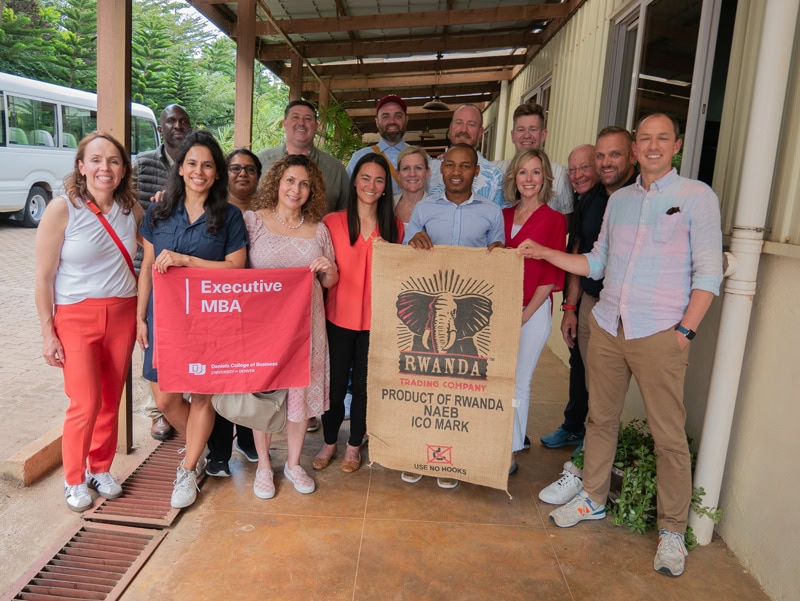
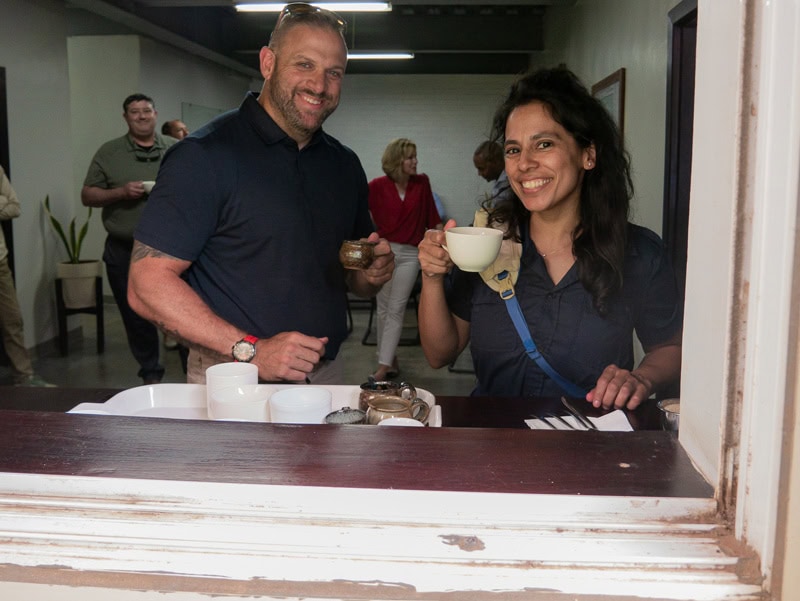
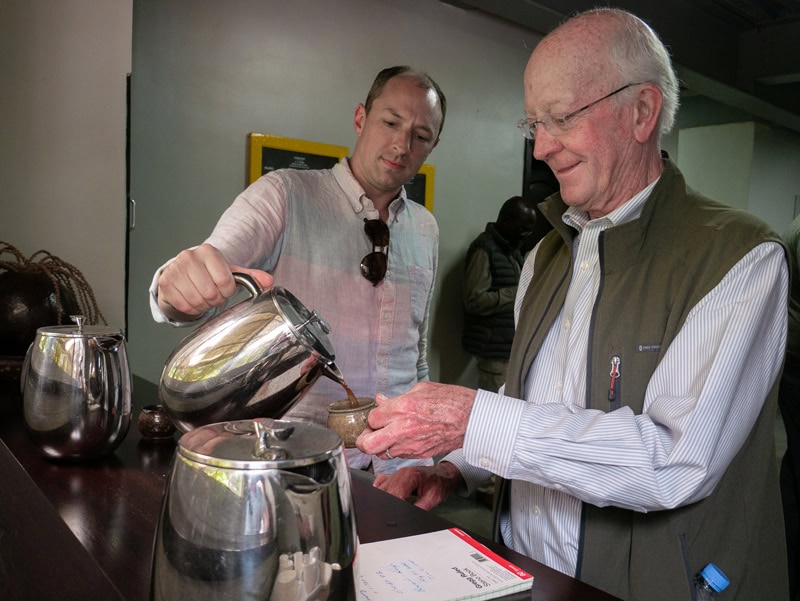
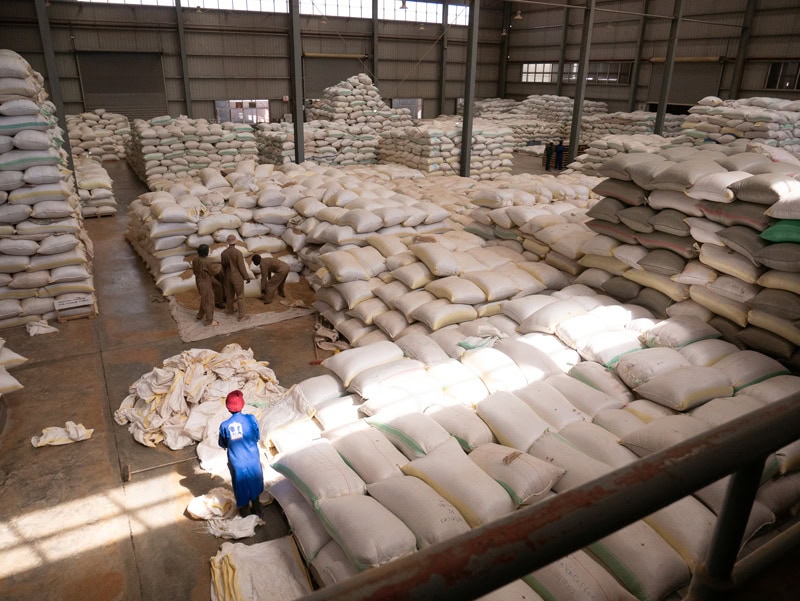
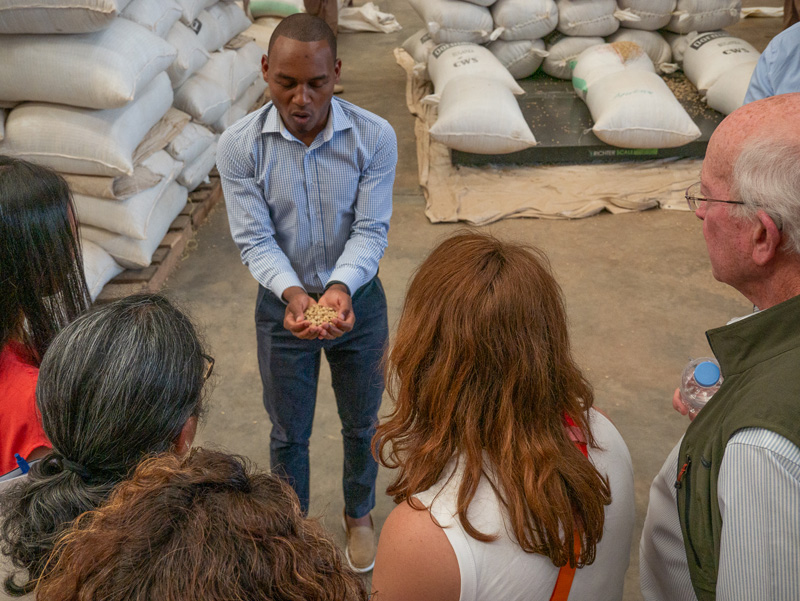
The Rwanda Trading Company is committed to securing economic freedom and security for smallholder farmers.
Creating Connections
Loaded into a trio of forest green Toyota Land Cruisers, students rattle to the rhythm of a rocky dirt road, through a busy town just outside of Kigali. It’s vibrant, full of bustling shops, sellers, buyers, children in schools. Home for most of these people, however, is on the other side of a deep gorge.
Until recently, crossing required either a perilous trip up and down steep stairs or a circuitous route that adds hours to any journey.
Bridges to Prosperity connected the two sides of the settlement, part of its ongoing work to create safe, efficient methods of passage so kids can get to school, income-earners can go to work and the needy can reach hospitals.
The nonprofit, students are surprised to learn, has a headquarters in Greenwood Village, Colorado. That’s not a coincidence. Daniels faculty want students to interface, when possible, with organizations that have ties to DU’s local community. Doing so offers opportunities for students to stay involved with the organizations they meet. Mere minutes after a meeting at the NGO’s headquarters, several say they plan to pitch their companies on partnerships.
“It was a privilege to see this,” student Leticia Robledo tells regional impact manager Oliver Bagwiza. “We will carry your voice forward.”
Bridges provide vital, safe connections between homes, schools, hospitals and other services. And they can save hours of commute time.
Bridges to Prosperity identified more than 5,500 locations globally that would benefit from the installation of a safe crossing. To date, it has built 247 in Rwanda.
The trail bridges constructed allow travel by foot, bicycle or small vehicle. The nonprofit leverages locally sourced and repurposed materials.
Driving away from the bridge, student Justin Magnall looks out the window at the sea of people walking and biking through Rwanda’s arterial byways, dodging traffic, carrying seemingly impossible quantities of goods on their heads. He looks at the houses up and down the hills, accessible only by steep footpaths.
“Yesterday, I just thought this was a lot of people. Now, I’m wondering where they’re going and where they came from,” he says. “In business, it makes me think, ‘What are all the things we don’t see in everything everybody does?’ It’s this little metaphor for all the things that are hidden.
“It’s amazing how quickly the lens changes.”
When all is said and done, the cohort will have visited 17 companies—everything from a craft brewery to a geothermal power plant to a mobile phone commerce company. Each strengthens the University’s connection to the world around it. Year after year, even as careers and conditions change, businesses in so many countries welcome Daniels students back with open arms.
At each stop, the curious students ask deep questions based on their secondary research and what they’ve experienced on the ground. Because of this course and this trip, every company’s work feels relatable.
“They’re all businesses in the end. They speak the same language,” says Jade Buckler, a retired U.S. Navy officer looking for his next career. “We’ve been given all of these tools about how businesses operate, analyze and manage their supply chains and all the logistics behind it. Now, when the rubber meets the road, we want the answers to all of the questions we’ve been reading a case study about.”


Over the course of the entire journey to Africa the cohort visited 17 companies.
Here is a quick look at them all

Bridges to Prosperity
Structures to end the rural isolation that can be a root cause of poverty
Eden Care
Digital, affordable, efficient health insurance
Impact Hub
Connections and programming for entrepreneurs
KenGen
Geothermal, thermal, wind and hydropower that creates 60% of Kenya’s electricity

Kwenza Brewery
Craft beer, brewed by women, that supports women and the local economy
M-PESA
Secure payment, deposits, withdrawals and transferring of money through mobile phones

McKinsey & Company
Consulting services to drive sustainable, inclusive growth across industries and regions
Oserian
Cut flowers sustainably grown and exported to markets around the world
Pathways, Konza, AmCham, Trimble
Companies and agencies creating economic opportunity and a “Silicon Savannah” technopolis
Rwanda Development Board
A one-stop shop center for permits, licenses and skill building
Rwanda Trading Company
Ethically sourced coffee and training programs for farmers
Victory Farms
Tilapia and other “white protein,” produced, processed, distributed and sold through an end-to-end platform
Zaria Court
A vibrant hub for sports, culture, hospitality and entrepreneurship
Zipline
Drone-delivered access to health care, consumer products and food
Fun, With a Purpose
As its time in Rwanda winds down, Cohort 82 hops back in Land Cruisers and makes a winding drive to the northern part of the country. In 24 hours, students will take their first steps into Volcanoes National Park, for an experience they will never forget.
Nearly all of the students have purchased gorilla permits, allowing them to trek through the park and spend an hour with the world’s largest primates in their natural habitat.
Students are led by experienced guides, who work with trained trackers to zero in on each clan’s location. The intensity of the treks varies; the group that has opted for the more difficult hike spends more than half an hour ducking, plucking and sidling through branches and grasses, following a tracker who slashes a path with a machete. They stop, sip some water and put on surgical masks. Then, the guide leads them forward.
Students gasp and snap photos at the family of 12 animals that sits, quite literally and quite calmly, inches from them.
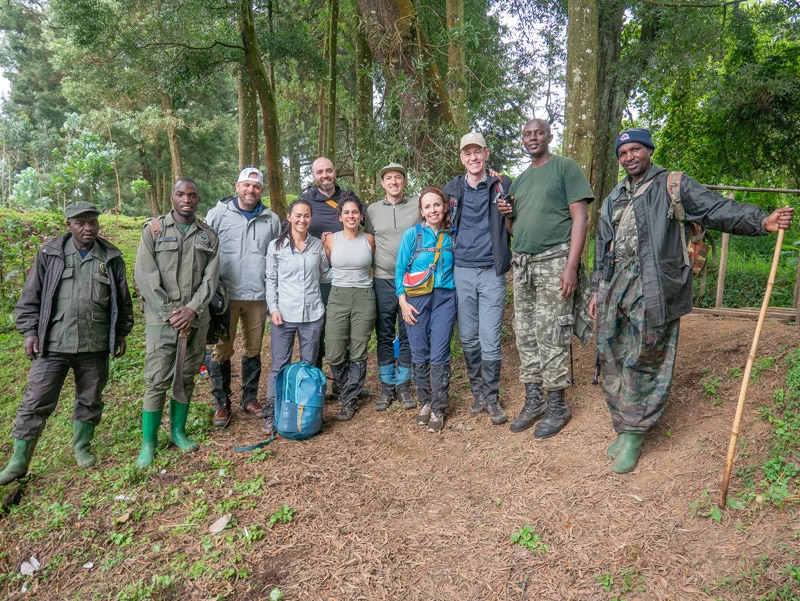
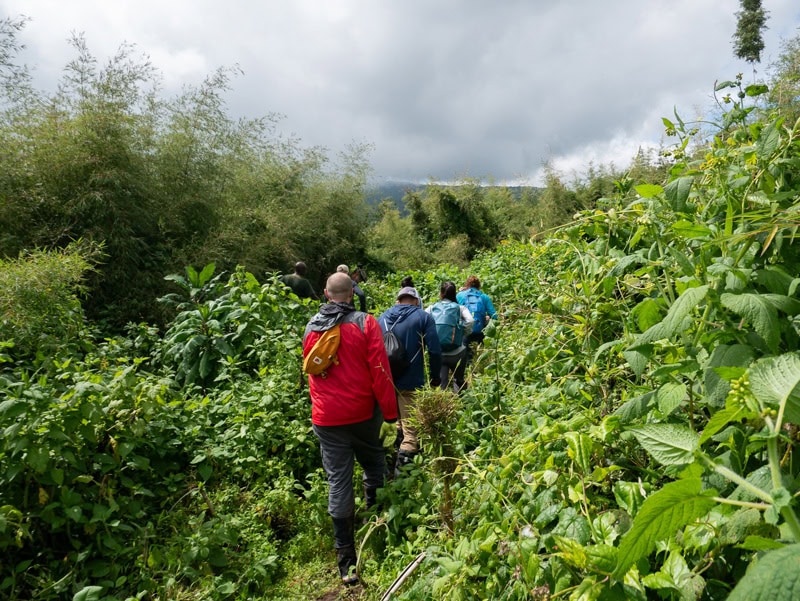
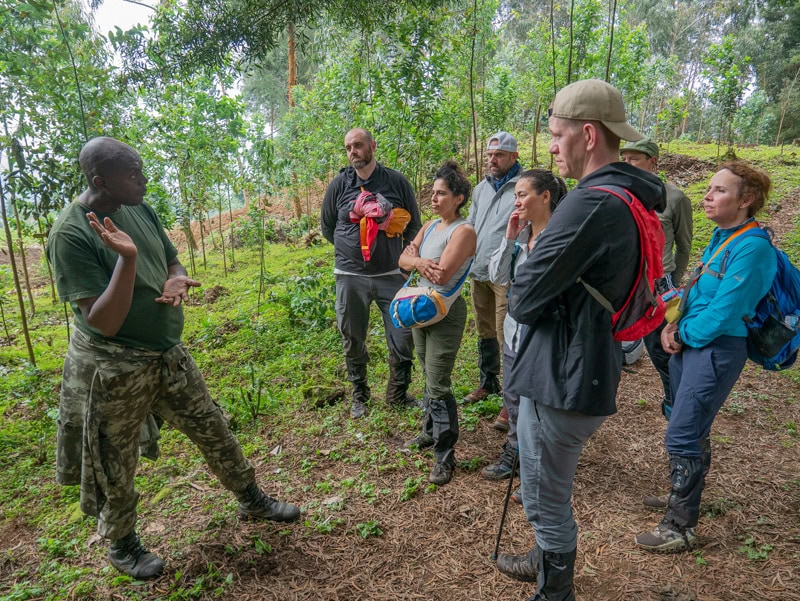
Experienced guides and trackers led EMBA students on a trek through Volcanoes National Park for an encounter with gorillas.
After the devastation of the Rwandan genocide, gorillas helped put the country back on the map for the right reasons. Now, thousands of people each year get to see Rwanda through their own eyes and leave transformed. In other words, the EMBA students are not just trekking to the gorillas for tourism.
“They’re a big part of Rwanda’s story,” Cahal says of the animals. “Business doesn’t operate in a vacuum. If you don’t see some of the other things that are important to a country, like the gorillas, which are a huge source of pride here, then you don’t understand the picture.”
When the students exit the forest, the guide tells them about the way these treks benefit the rural communities that abut the park. Each year, the permits fetch around $30 million for the country, 10% of which is returned to the small towns that border the forest.
Plemmons reminds students that this trip is full of fun—with a purpose. The breathtaking experiences they have are tied to each country’s economy. Plus, the “neural pathways they burn” will keep them returning to their time in Rwanda, and the business lessons that came with it.
“If you don’t see some of the other things that are important to a country, like the gorillas, then you don’t understand the [economic] picture.”

Photo by Forrest Hanson
Video by Jordan Lawver

Photo by Claudia Flores
Photo by Robert Nanney
Photo by Robert Nanney

Photo by Forrest Hanson
Kenya
The cohort says goodbye to Kigali and hello to Nairobi—the first time a Daniels class has ever set foot in Kenya. After five days getting to know the Rwandan capital, it quickly becomes clear that the two cities are very different from one another.
Nairobi’s population is five times larger than that of Kigali’s, which is reflected in the multilane highways, American chain stores and prominent billboards for big brands. Aspiring social media influencers flood popular downtown areas with cell phone-holding tripods and light diffusers.
The cohort’s tour bus passes Nairobi’s Kibra slums, home to about a million people. A vibrant, resilient, innovative, creative community lives here, even amid the dilapidated tin roofs, incredible density and outbreaks of disease.
In the back of the bus, student Greg Anderson stops his conversation with EMBA executive director Jenny Dobmeier. Questions about finding a dream job feel far less significant in this moment.
“I have water, I have food, my son is getting an education,” Anderson says. “I’m worried about if he’s going to make the soccer team and they don’t even have a soccer ball.”


Building International Networks
The bus stops outside the home of Joel Onditi (MBA 2010), the president and CEO of Pathways International, who is determined to turn his home country into a “Silicon Savannah.”
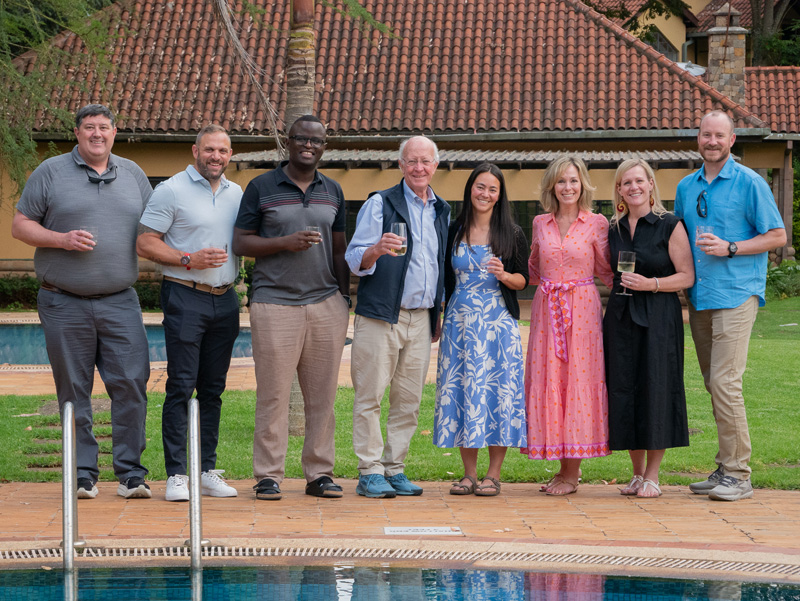
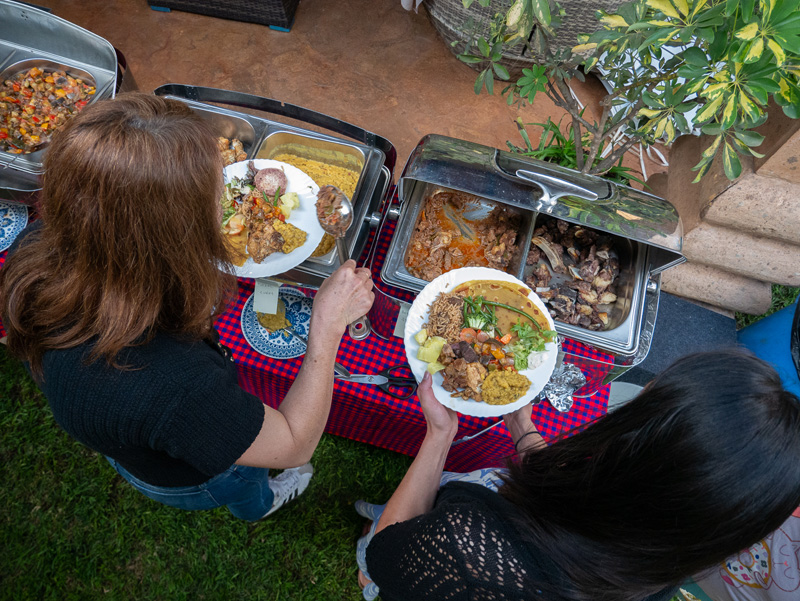
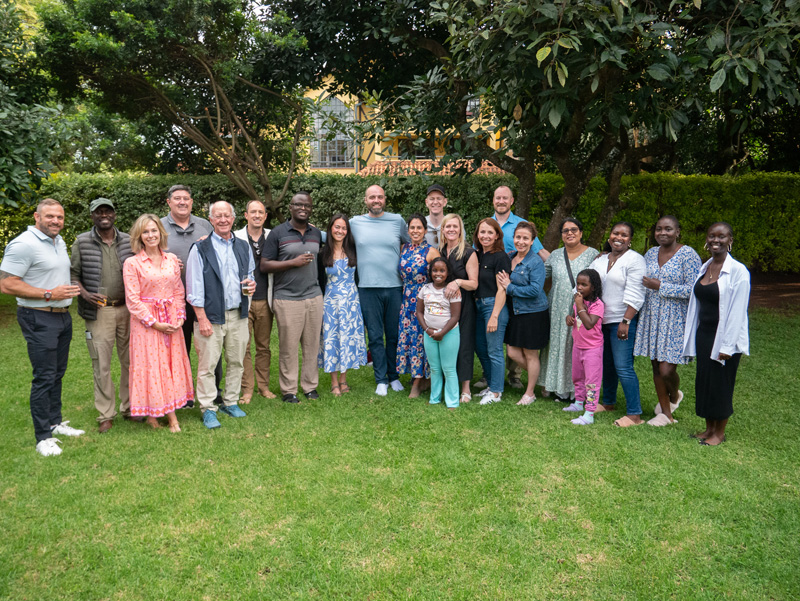
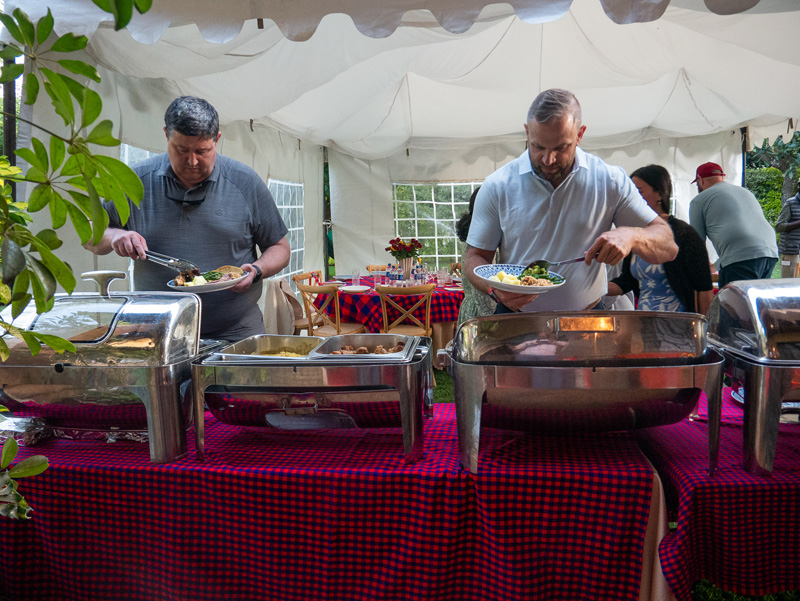
Onditi greets students and introduces them to his wife, kids, sister, sister-in-law, nieces and nephews. Then the cohort buries its dinner plates beneath a homemade buffet of traditional Kenyan cooking. By the time the night ends, students have played with Onditi’s children and cleared out the living room for a dance party. Naturally, they swap business cards and LinkedIn profiles too.
This is the Daniels network in living color: 40,000 alumni all over the world, willing to help, however they can. While students on global trips frequently meet Daniels alumni, it’s not every day a cohort spends time in a local home with an entire family.
Dig Deeper: How Joel Onditi is working with the Kenyan government to provide education and opportunities in the tech sector. Read
Connections, ultimately, are the name of the game in the Executive MBA program. Cohorts become close over the course of their 18 months together, sparking friendships and even professional partnerships that last a lifetime.
Faculty are plugged in too. Drop the name of an alum and Cahal, Dobmeier and Plemmons can tell you their cohort number, their background and, often, what they’re up to now.
“The strength and longevity of our EMBA alumni network, and the relationships between our faculty and students, are key differentiators of our program,” Dobmeier says. “We recognize that our students are navigating pivotal next chapters in their careers, and we meet them with the support, shared experiences and collaborative learning that fuel those transitions. The needs of our professional students are our compass for fostering the unique, long-term bonds that define our alumni community.”
Though the days are filled with company visits and cultural activities, many important conversations happen in between, as the Daniels crew commutes from one site to the next.
For Kerry Plemmons, “It’s magic how well we get to know people.”
“The bus is a big deal. It’s a real big deal, it’s a real big part of this. We don’t sit with the same students. We rotate around—front of the bus, back of the bus. It’s magic how well we get to know people. We hear about their kids. I taught MBA for years in a regular classroom. Yeah, you get to know them. But not like this. We become buddies. And then when I have another student that says, “I need to meet somebody at the Adams County Sheriff,” I know somebody at the Adams County Sheriff. Your memory of a person is deeper when you associate that person with an event like last night, like with gorillas. These buses mean a lot to me.”
One of the program’s most important purposes is career advancement. Faculty are eager to help their students “connect the dots” between things they do and things they love.
In the back seat, Plemmons prods a student about his passions: What does he want to do? And, more importantly, Plemmons asks, “How do we get you there?”
One of the program’s most important purposes is career advancement, Plemmons says later. The curriculum provides skills, but the EMBA team is eager to help their students “connect the dots” between things they do and things they love.
“The bus is a big deal,” Plemmons explains. “It’s just magic how well we get to know the students. We become buddies, friends. And then when I have a student who says, ‘I need to meet someone at the Adams County Sheriff,’ I know someone at the Adams County Sheriff. Your memory of a person is really deeper when you associate that person with something like gorillas (in Rwanda). These buses mean a lot to me.”
Nairobi National Park and Sheldrick Wildlife Trust

Students load up in Land Cruisers once again and venture to Nairobi National Park for an afternoon game drive. Heads peeking through popped roofs, cameras in hand, students watch in awe as a family of giraffes crosses their paths. Hippos, water buffalos, rhinos, ostriches and countless birds make appearances too. The next day, they visit Sheldrick Wildlife Trust and its elephant orphanage. Tourism accounts for one of every 12 jobs in the Kenyan economy and contributed 1.7 trillion Kenyan Shillings in 2025, according to the World Tourism and Travel Council.
Small Meetings, Big Impact
Through all the travel, company visits and cultural experiences, Cohort 82 has not lost sight of the assignment it must complete. A major purpose of this trip, after all, is gathering data to inform the feasibility studies for their respective business ideas.
The meetings they have arranged with real companies, government agencies and investors don’t necessarily take shape quickly or easily, even after making contact. Even those who have worked in international business say it’s taken an unusual degree of patience, a significant contrast to the work they may have done with organizations in, say, the European Union, which generally push Americans to conduct themselves more formally.
But once students make it to their face-to-face meetings, things begin to flow. A conversation at one company sparks a suggestion to talk to a colleague at a partner organization.
“I’m amazed at how many people and how many companies are willing to meet with us,” says Laura Hatanaka, a student who works at Filsinger Energy Partners. “I think it shows how readily people are willing to meet with you if you reach out.”
Her teammate, Jordan Lawver agrees.
“I think [the class has] given us the opportunity to pull threads organically that we otherwise wouldn’t have done if we were just following the itinerary,” adds Lawver, who works for Trimble. “It’s an allocation of networking. First and foremost, the skill of the cold call and trying to get someone to meet with you and then working networks and asking questions to work through people.”
Lawver and his teammates are crammed into an undersized Uber, weaving around motorbikes and through one of Nairobi’s slums, trying to find Africa Collect Textiles (ACT), a nonprofit that repurposes used fabrics and footwear destined for landfills. The student group wants to learn more about where the supply chain ends for a piece of clothing—important information as they sketch an idea for a product that uses old garments to filter drinking water.
Inside ACT, they walk past heaps of clothing at the end of its lifecycle. Items aren’t necessarily wasted because they’re of poor quality. They may not be the right size, jive with cultural taste or fit the local climate.
“My definition of ‘bad’ is different now,” Lawver says. “I feel fortunate to have got the look into this that we had. Because, outside of this trip, I would have come to a place like this, but as a window shopper who would have bought a couple things and not given a single thought to the underlying dynamics of what makes that place.”
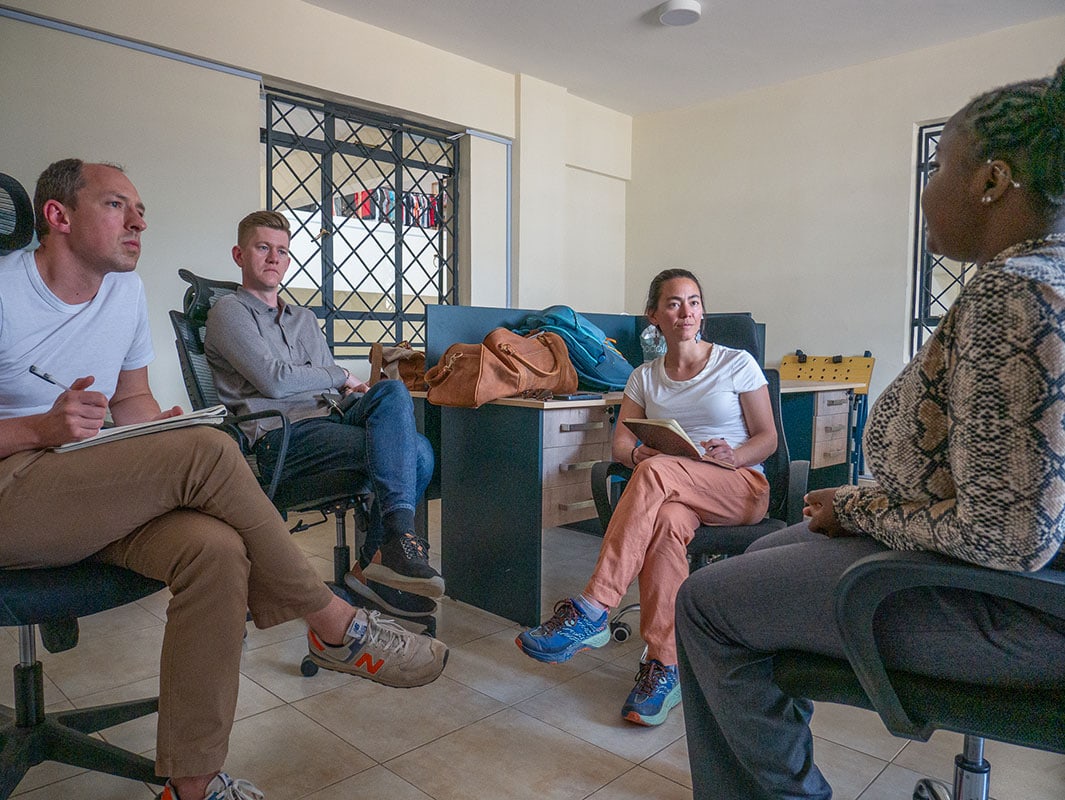
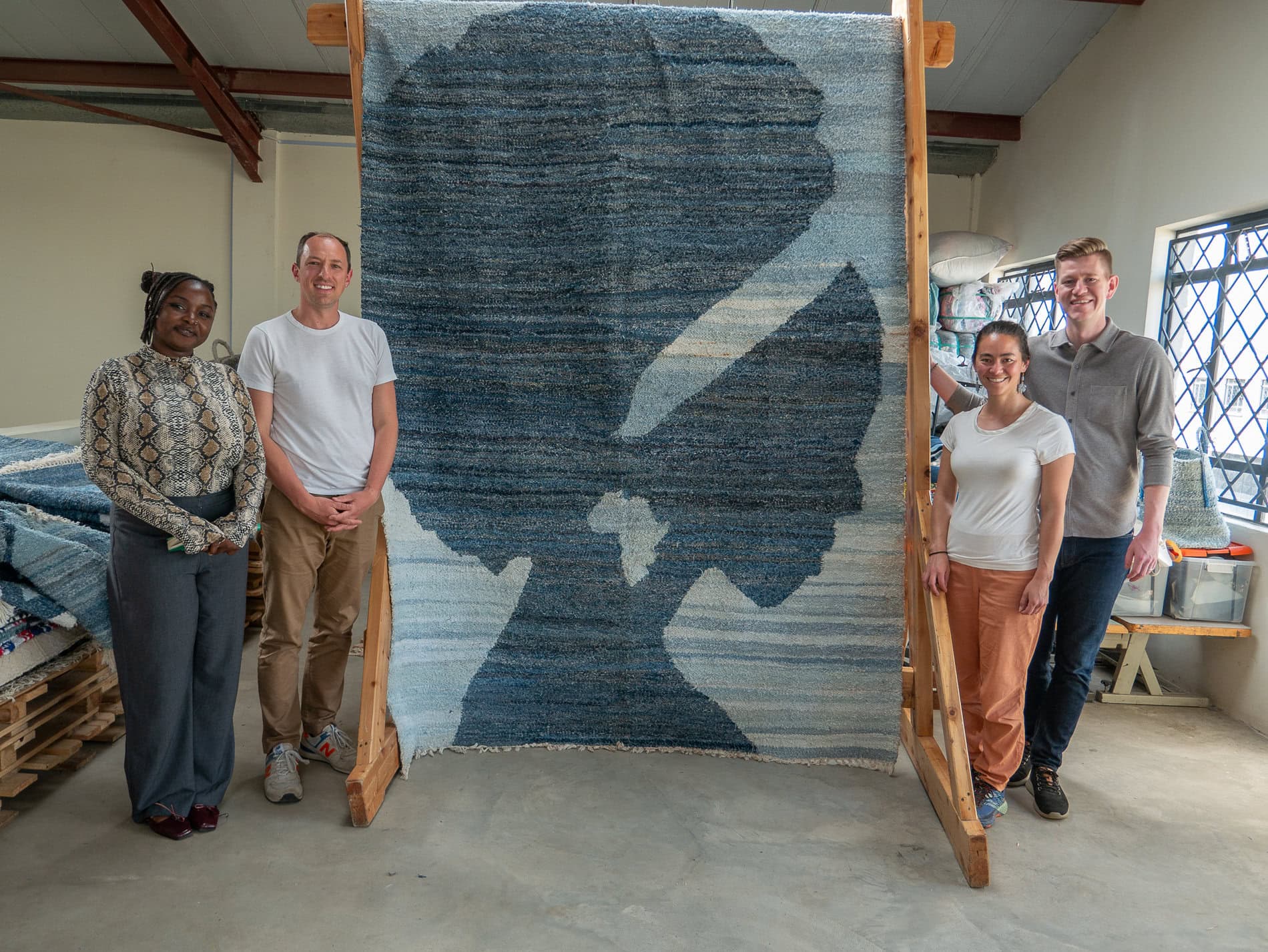
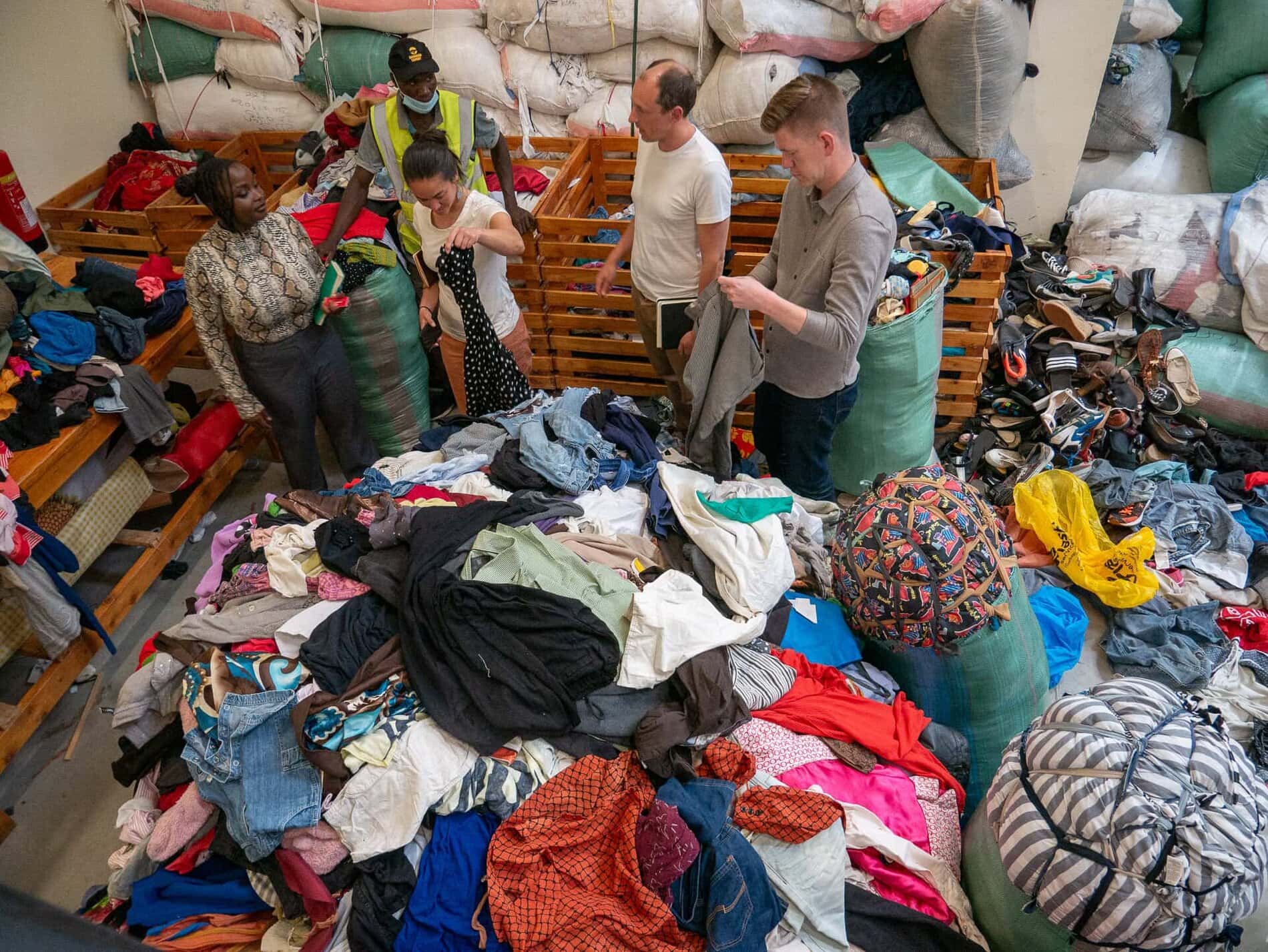
Students Laura Hatanaka, Forrest Hanson and Jordan Lawver visit Africa Collect Textiles to learn more about the supply chain for used clothing.
“Outside of this trip, I would have come to a place like this, but as a window shopper who would have bought a couple things and not given a single thought to the underlying dynamics of what makes that place.”
Meanwhile, another group of students waits outside a modest building, prepared to meet with the CEO and leading practitioner of Noble Veterinary Surgeons. The team is interested in the feasibility of telehealth for livestock in rural parts of east Africa.
What the Daniels students thought would be a simple face-to-face conversation with the CEO turns into a much larger affair. Noble staff stream in as the conversation begins; vets, vet students, associates and even receptionists shake hands and take a seat in the circle. In all, 13 Noble staff from four different branches are in attendance, answering the team’s questions before eagerly asking their own. The Kenyan team is overwhelmingly grateful for the visit and shows its respect with a cake. The students are incredibly flattered by the hospitality.
Debriefing in the Uber ride home, the team realizes that its feasibility study is way off base. The issue isn’t rural telehealth; it’s basic veterinary needs.
Not all feasibility studies prove feasibility, Plemmons reminds them

At Noble Veterinary Surgeons, Dr. Mwendwa Mulonzi answers questions about local clinics and their needs.

A Transformation Begins
For one final time, the students in Cohort 82 fill their plates and raise their glasses.
Their time in east Africa will come to a close after they complete one last assignment: a spoken reflection of their time together. What were the most important takeaways from the trip? And how will your experience will enrich your career moving forward?
“What lives in my heart is not the contrast, but the common ground,” says Gina Rodriguez, a veterinarian. “At one point in the trip I told someone, ‘Everything in life is work.’ But what I meant by this is: After this experience, I’m going home with a renewed commitment to be more intentional, to seek out more connections, to honor the stories that I’ve heard by the people I’ve met. I will do the work. I will face the challenge.”
As more and more students share their thoughts, three themes shine through: unity, humanity and awareness. The way they see the world has changed.


“Just because I think it’s valuable to have very quick access to clean water does not mean that everyone [prioritizes] easy access to clean water,” says Hatanaka, recalling a conversation she had through a small team meeting. “Taking away that 30-minute walk to go get water may be taking away that conversation that women have while they go collect that water. You should not just assume that because it’s the western way it’s the right way.”
Thomas Anyumba shares his thoughts too. He has been the cohort’s guide for the past 10 days, coordinating logistics, cultivating cultural experiences and translating what the students see and hear into something they can understand.
Safari, he reminds the cohort, is Swahili for “journey.”
“You’re not sure what you’ll see along the way,” he says, “but you have to approach it with excitement.
“Life is one long game drive.”